Anthropic’s Snowflake Deal and Glasswing Program Push It Deeper Into Enterprise Infrastructure
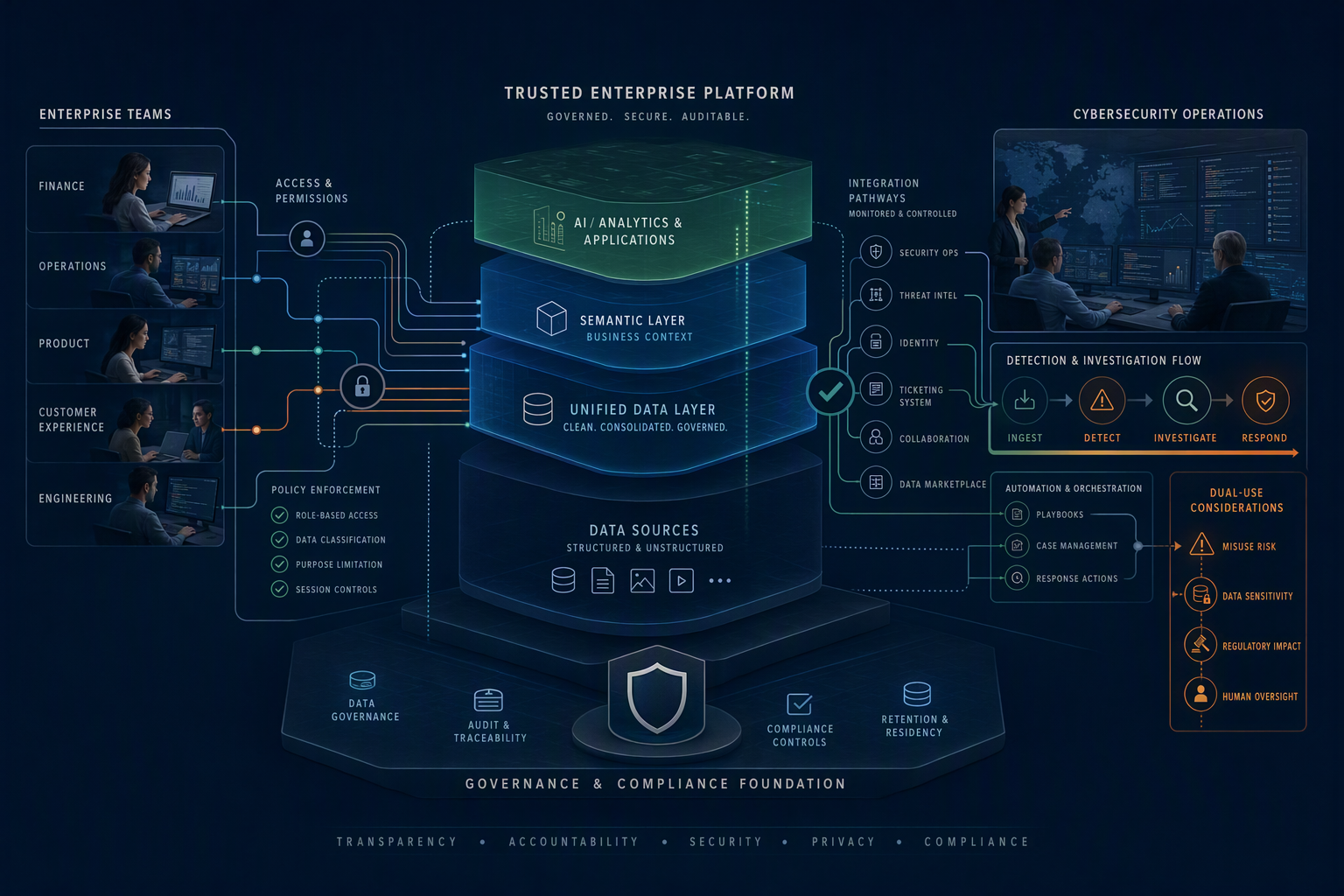
A major data-platform partnership and expanding cybersecurity deployments show Anthropic moving beyond model access toward governed enterprise integration, though much of the business impact evidence still comes from company reporting.
Anthropic’s enterprise strategy is becoming easier to track in operational terms. Rather than relying only on direct chatbot adoption, the company is expanding through partner platforms and security-focused deployments. Two developments stand out in the public record: a multi-year $200 million partnership with Snowflake that distributes Claude across a large enterprise data environment, and Project Glasswing, a cybersecurity initiative that Anthropic says has already been used by dozens of organizations to identify serious software vulnerabilities. Together, they suggest Anthropic is trying to become part of enterprise infrastructure rather than just another model provider. But the public evidence still has important limits. Distribution and usage signals are clear. Independent validation of business outcomes is not.
The strongest verified enterprise signal comes from Snowflake. Snowflake and Anthropic first announced a strategic partnership in November 2024 to make Claude models available within Snowflake Cortex AI on AWS. They expanded that relationship in December 2025 with a multi-year $200 million agreement.
According to Snowflake, the expanded partnership makes Claude models available across its AI Data Cloud and joint go-to-market efforts for agentic AI deployments. Snowflake said the deal extended Anthropic’s reach to more than 12,600 customers and that thousands of customers were already processing trillions of Claude tokens per month through Cortex AI.
That matters because it shows a practical enterprise distribution path. Large organizations often adopt frontier models through existing governed platforms rather than through standalone tools. If Claude is used inside Snowflake environments, adoption becomes tied to enterprise data access, permissions, compliance controls and existing workflow systems.
The second major signal comes from security operations. Anthropic launched Project Glasswing in April 2026 as an initiative focused on securing critical software with Claude Mythos Preview. In May, Anthropic said about 50 partners had used the system to find more than 10,000 high- or critical-severity vulnerabilities. In June, the company said it was expanding the program to about 150 new organizations in more than 15 countries.
Those claims are significant because they point to real use in sensitive workflows, not just internal experimentation. Security and critical-infrastructure software are among the highest-stakes enterprise use cases for AI. If accurate, Glasswing suggests that Anthropic’s models are being used in live vulnerability-discovery processes where speed and technical depth matter.
But the limits are equally important. Snowflake’s customer and token figures are company-reported. They show distribution and usage potential, not independently verified business value. Likewise, Glasswing’s vulnerability counts come from Anthropic’s own reporting. They indicate activity and partner participation, but they do not by themselves establish net security improvement, remediation speed or downstream operational benefit.
That distinction matters for enterprise buyers. Model providers increasingly highlight ecosystem reach, token volume and security outputs as proof of traction. Those are useful indicators, but they are not the same as measured productivity gains, cost savings or reduced incident risk.
Even so, the practical implications are clear. Anthropic is moving toward enterprise infrastructure in two ways. First, it is embedding through platforms already trusted for governed data access. Second, it is targeting specialized, high-value workflows such as vulnerability discovery, where enterprise willingness to pay is often tied to risk reduction rather than general productivity.
This also raises governance questions. In the Snowflake model, AI use happens inside a data environment with existing enterprise controls. That may make adoption more attractive for regulated organizations that want auditability, permissions management and compliance alignment. In the Glasswing model, however, the governance issue is dual-use risk. A system that can find serious vulnerabilities for defenders could also have offensive value if controls fail.
Anthropic’s own public framing reflects that concern. The company has said Glasswing is meant to secure critical software while acknowledging the risks associated with advanced vulnerability discovery. That makes this more than a business-expansion story. It is also a story about how frontier AI capabilities are being routed into sensitive operational contexts with both defensive and misuse implications.
For security teams, the near-term change in practice may be faster vulnerability triage and identification, combined with heavier pressure on remediation and disclosure workflows. Finding flaws is only one part of the security process. If AI increases discovery volume, organizations still need the people, governance and coordination required to verify, patch and disclose issues responsibly.
For enterprise data teams, the implication is different. Claude’s growth through Snowflake suggests that frontier AI adoption may increasingly happen through existing enterprise platforms rather than separate experimentation environments. That can simplify procurement and governance, but it can also make AI dependence more deeply embedded in core infrastructure choices.
The public record does not yet support stronger claims that Anthropic’s enterprise push has broadly transformed regulated-industry operations or delivered independently verified ROI at scale. But it does support a narrower and important conclusion: Anthropic is gaining meaningful enterprise footholds through governed platform distribution and security-specific deployment, and those footholds carry both commercial and governance consequences.