AI Governance Is Converging in Structure, Not in a Single Global Rulebook
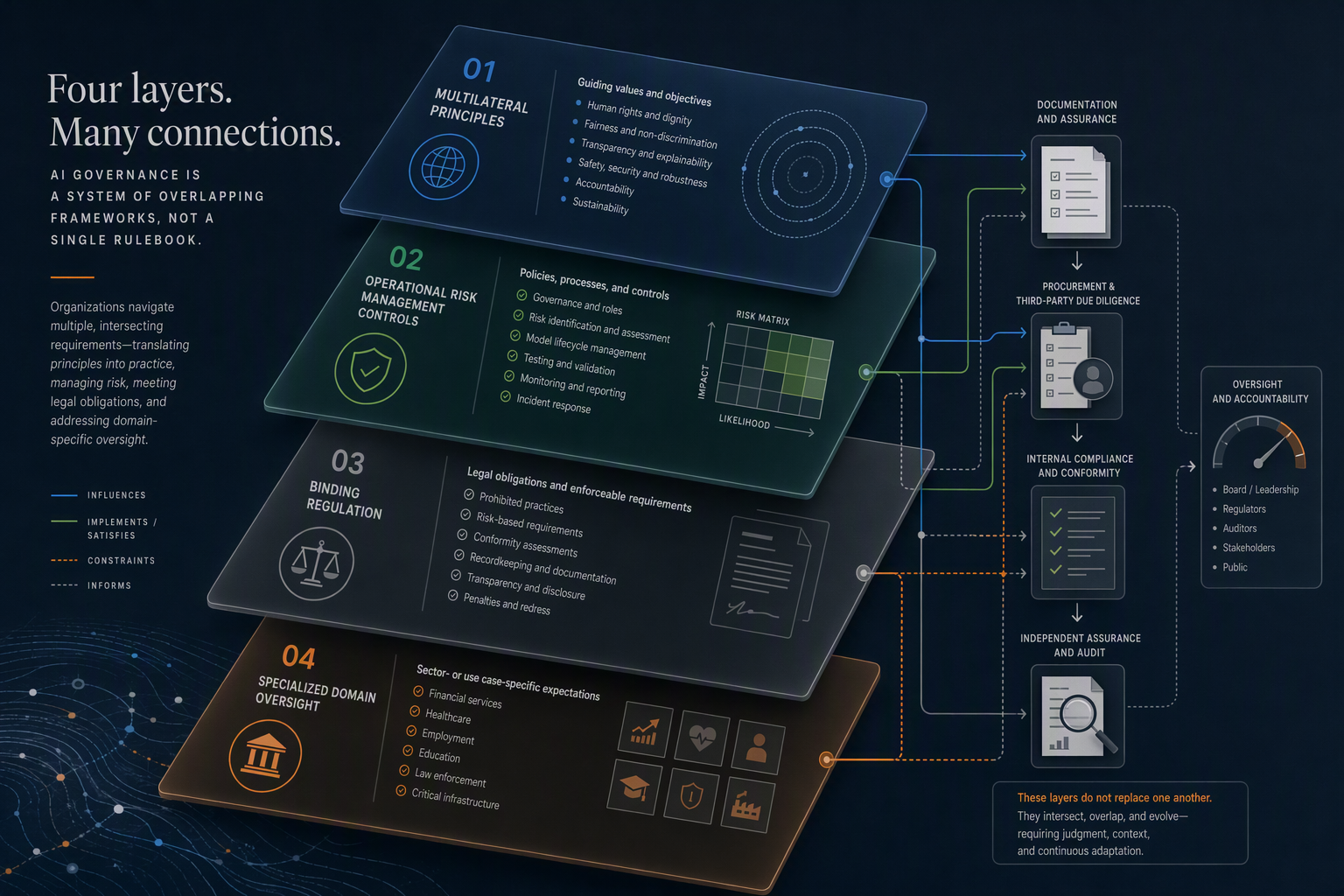
New multilateral statements, operational risk frameworks and domain-specific guidance are creating a layered compliance environment for organizations using AI.
AI governance is becoming more consequential for organizations not because the world has agreed on one universal framework, but because several kinds of frameworks are beginning to overlap. Broad international principles, operational risk-management tools, binding regional rules and specialized domain guidance now increasingly sit on top of one another. For companies, public agencies and procurement teams, the practical implication is clear: AI governance is no longer a matter of voluntary principles alone. It is becoming an operational requirement that affects compliance, assurance and purchasing decisions.
The current AI governance landscape is best understood as convergence in structure rather than harmonization in substance. Recent developments from the G20, UNESCO, NIST and the European Commission suggest that organizations are facing a more layered system of expectations, even though no single global model has emerged.
At the top layer are broad multilateral principles. UNESCO’s Recommendation on the Ethics of Artificial Intelligence, adopted by member states in 2021, remains one of the most widely referenced global ethics baselines. UNESCO submitted its first consolidated implementation report in 2025, showing that the recommendation has moved from adoption into monitoring and national implementation. The OECD AI Principles continue to serve a similar role as a high-level reference point in international policy discussions.
A second layer consists of operational governance frameworks that help organizations translate principles into internal controls. NIST’s AI Risk Management Framework, first released in 2023, has become a prominent example. It is voluntary, but widely used as a reference for risk mapping, governance processes and implementation guidance, including for generative AI use cases.
A third layer is binding regulation. The research package identifies the EU AI Act as the clearest example of enforceable legal obligations shaping global compliance behavior, particularly for organizations that serve European markets. Even where firms are not directly headquartered in the European Union, the act is becoming a reference point for documentation, assurance and risk classification.
A fourth layer is emerging in specialized domains. On 8 September, the European Commission published recommendations from the European Group on Ethics in Science and New Technologies calling for a new governance approach for Neuro-AI. According to the Commission, the recommendations argue for stronger safeguards around neurodata and inferences derived from it. That development matters because it shows how general AI governance principles are now being adapted for higher-risk and more sensitive application areas.
The G20’s latest statement adds to this pattern. According to the research package, ministers adopted the G20 Innovation Ministerial Statement in Chapel Hill on 2 September 2026 and issued related AI Prosperity Objectives. The statement emphasizes sector-specific, risk-based approaches, national sovereignty in governance and policy support for innovation and workforce preparation. That does not create binding law, but it reinforces a policy direction already visible elsewhere: governments increasingly support a risk-based approach rather than a single uniform model.
For organizations, this layered structure has several practical consequences. The first is that governance can no longer be handled as a standalone policy document. Enterprises increasingly need crosswalks between principles, internal controls and legal obligations. A code of ethics or an AI principle statement may still be useful, but it is not sufficient if procurement teams, legal functions and model owners also need documentation, risk classification and audit trails.
The second implication is that sector context matters more. A general-purpose governance framework may be enough for low-risk productivity tools, but not for systems touching health, finance, education, employment or neurotechnology. As specialized guidance expands, organizations will need to determine where horizontal governance ends and domain oversight begins.
The third implication is procurement. Public-sector buyers and large enterprises increasingly want evidence that vendors can map their systems to recognized governance frameworks, whether that means NIST-style risk management, alignment with international principles or readiness for EU-style legal compliance. In practice, governance is becoming part of vendor selection, contract review and assurance processes.
The evidence, however, does not support claims that the world is moving toward one unified AI governance framework. The source set points instead to complementary but distinct layers. Multilateral principles help define shared norms. Operational frameworks help institutions manage risk. Regulations impose legal duties in specific jurisdictions. Specialized oversight addresses especially sensitive applications. These pieces are interacting more often, but they are not fully harmonized.
That distinction matters because organizations can misread convergence as simplification. In reality, the compliance challenge may be growing. A company operating across regions may need to show alignment with broad ethical principles, maintain internal risk controls, meet regulatory obligations in some markets and prepare for sector-specific scrutiny in others.
There are also evidence limits. Much of the language around framework convergence comes from comparative analyses and policy interpretation rather than formal official crosswalks between systems. The research package notes that specialized governance remains uneven and emergent across domains. That means organizations still face ambiguity when trying to map one framework onto another.
Even so, a pattern is visible. AI governance is becoming more operational, more document-driven and more sensitive to use case and sector. This shifts the question for enterprises from “Which single framework should we follow?” to “How do we build a governance program that can satisfy multiple overlapping expectations?”
In practice, that often means governance teams need to work more closely with procurement, legal, security and business units. They need inventories of AI systems, risk-tiering processes, vendor assessment methods and escalation paths for higher-risk uses. For policy teams, the change is from principle-setting to implementation. For enterprise leaders, the change is from abstract AI ethics discussion to operational accountability.
The near-term message is not that a global AI rulebook has arrived. It is that the governance environment is getting denser, and organizations that treat governance as a one-time policy exercise may find themselves unprepared for procurement demands, regulatory documentation requests or domain-specific oversight.