AI Coding Tools Are Reshaping Software Workflows, but Productivity Claims Still Need Careful Scrutiny
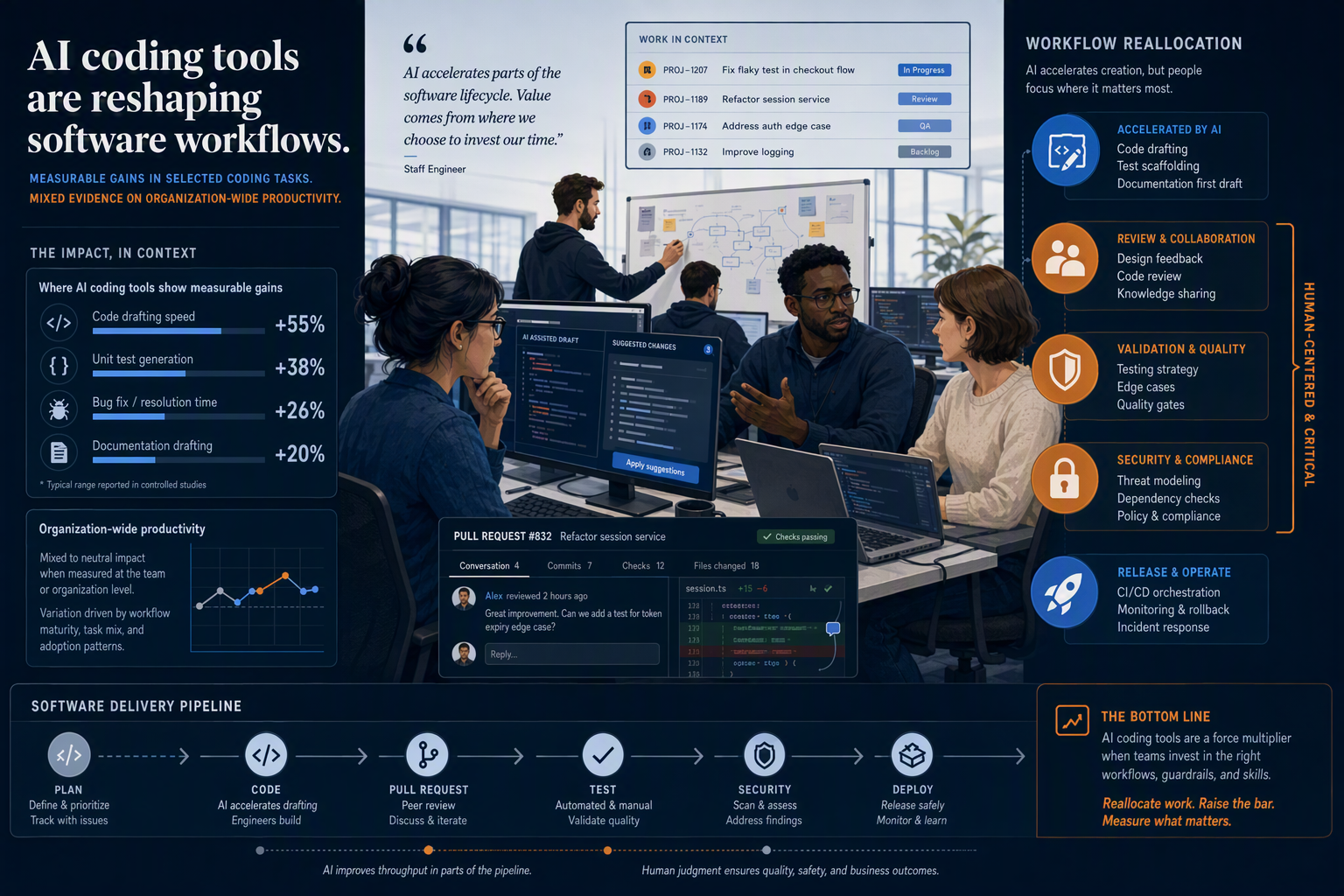
Controlled studies and company case studies show measurable gains in selected coding tasks, but much of the public enterprise evidence remains vendor- or company-reported and does not establish uniform organization-wide impact.
Software engineering remains one of the strongest public test cases for how generative AI is changing day-to-day work. Compared with many enterprise AI categories, coding assistants generate measurable workflow data: task-completion time, pull request throughput, cycle time, and incident-response metrics. That has produced a more substantial evidence base than exists for many other forms of knowledge work. But it has not resolved the central question for technology leaders. The public record shows that AI coding tools can improve selected tasks and some team-level metrics. It does not show that every engineering organization should expect the same gains, or that faster drafting automatically translates into faster, safer software delivery.
The strongest causal evidence still comes from controlled research rather than enterprise marketing. Microsoft Research and GitHub reported in 2023 that developers using GitHub Copilot completed a representative coding task 55.8% faster than a control group, with completion time falling from 2 hours 41 minutes to 1 hour 11 minutes.
That finding matters because it measures a concrete task under controlled conditions. It is more robust than broad claims that AI makes software teams universally more productive. But it is also limited. A controlled task is not the same as an end-to-end production workflow. Enterprise software delivery depends on code review, testing, integration, release management, security checks and coordination across teams.
More recent public evidence points to measured gains in narrower operational metrics, though much of it is company-reported rather than independently benchmarked. OpenAI said in a case study published on 8 September that 1Password measured a 20.9% productivity increase in its core Codex cohort and a 10.9% reduction in median pull request cycle time. OpenAI also said one complex production issue that had previously taken weeks to investigate was handled in about a day, which it described as roughly a 90% reduction in investigation time. The company further said 1Password estimated the deployment created about $0.8 million in annual engineering capacity value.
Google Cloud reported similar workflow metrics from CME Group. In its customer case study, Google Cloud said the company saw more than 10 hours of productivity gains per developer each month, a 45% increase in pull requests during a pilot and an expansion from 20 pilot users to more than 1,000 active users.
Other vendors and service providers have published similar accounts. HCLTech said a Gemini Code Assist deployment accelerated delivery times by about 25%, improved test coverage by about 60% and automated about 80% of manual scripting tasks in a middleware case study. Microsoft and GitHub have separately described large-scale Copilot deployment at Accenture, while AWS has published a separate account of Accenture using CodeWhisperer in some workflows.
Taken together, those examples suggest coding assistants are not confined to lab tests. Large organizations are integrating them into production engineering environments and measuring operational effects. But the public evidence is uneven in quality. OpenAI, Google Cloud, Microsoft, GitHub, AWS and HCLTech all have commercial incentives to highlight favorable results. Their case studies are useful signals, but they are not independent benchmarks.
The evidence becomes more mixed when researchers look beyond tightly bounded tasks. According to the replication addendum in the research package, later field and mixed-method evidence suggests that measured gains depend heavily on what organizations track. A NAV IT case study found no statistically significant change in commit-based activity after Copilot adoption despite positive self-reported productivity. Secondary reporting on other field evidence points to positive output effects, but the reviewed source set does not provide a uniformly replicated production-setting benchmark.
That divergence matters in practice. It suggests that productivity depends not only on model capability, but also on what an organization measures. Time to complete a defined task, commit activity, pull request volume, cycle time, review burden and developer self-reports may all move differently.
For engineering leaders, the most important change in practice is workflow reallocation. Developers are likely to spend less time on boilerplate coding, first-draft tests, documentation and some debugging work. They are likely to spend more time on review, integration, validation, architecture decisions and higher-level problem framing. In that sense, AI coding tools appear to shift work rather than eliminate it.
That shift can create new bottlenecks. If developers draft code faster, teams may see more pressure in code review, testing and security assurance. Some industry commentary and synthesis cited in the research package suggest AI-generated code can increase downstream review work or introduce quality and security risks. The current public evidence does not quantify that tradeoff consistently across companies, but it is strong enough to matter operationally.
Security controls are therefore becoming part of the productivity story. In May, 1Password announced an integration that allows OpenAI Codex to use credentials through the 1Password Environments MCP Server without exposing secrets in prompts, code or model context. That illustrates a broader enterprise requirement: coding agents need guardrails around credential handling, code provenance, access rights and auditability before they are given deeper access to production systems.
NIST’s AI Risk Management Framework offers one reference point for organizations building those controls. In practice, governance for coding assistants is less about abstract ethical language than about operational questions: what repositories the tools can access, how generated code is reviewed, how outputs are tested, and who remains accountable when defects or vulnerabilities reach production.
There are also workforce implications. The research suggests less-experienced developers may benefit more on defined tasks, potentially narrowing some experience gaps at the drafting stage. But the long-term effect on skill development remains unclear. If junior staff rely heavily on generated code, organizations may need to rethink how they build engineering judgment, debugging skill and architectural understanding.
The most defensible conclusion from the current evidence is narrower than many marketing claims. Yes, AI coding tools can improve selected tasks and some workflow metrics. No, the public record does not yet support a universal productivity uplift across all engineering teams. And no, the evidence reviewed here does not show that software engineering can be automated end to end or that labor needs will fall directly as a result.
For enterprises, that means rollout discipline matters more than license counts. The organizations reporting the clearest gains are measuring specific workflows, integrating tools into existing systems, training developers and building security controls around use. The question is no longer whether coding assistants can help. It is whether companies can redesign engineering workflows so that gains in drafting speed translate into better delivery outcomes rather than simply moving the bottleneck elsewhere.