AI Is Moving Into Food Security Operations, but Evidence of Beneficiary Impact Remains Limited
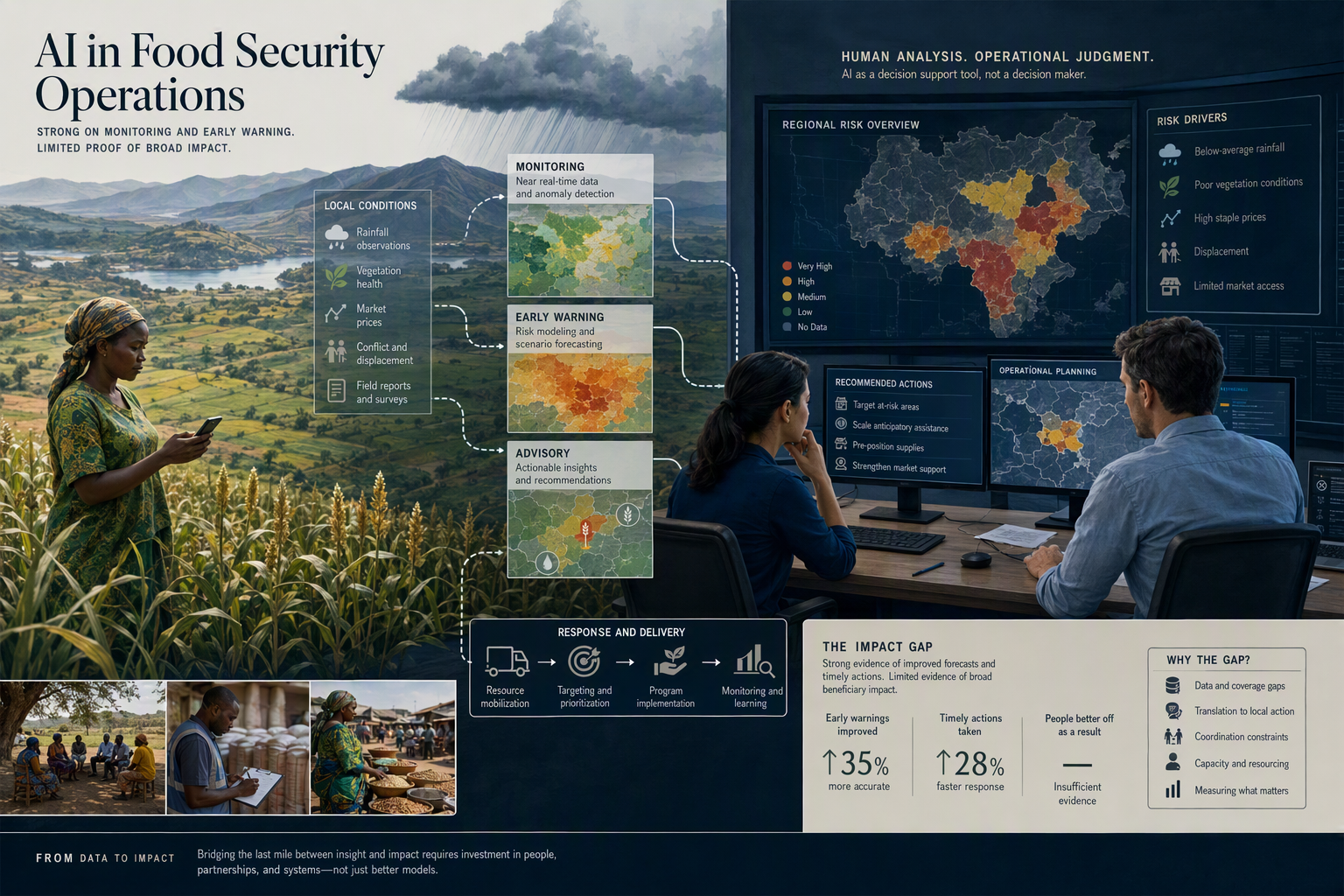
Public materials from WFP, FAO, CGIAR and the World Bank show real operational use in monitoring, early warning and advisory workflows, though most sources do not yet establish broad, measured outcomes for affected communities.
AI use in food security and agriculture resilience is moving beyond strategy documents. Multilateral agencies, research organizations and development institutions are now documenting operational tools for hunger monitoring, early warning, advisory support and program design. That shift matters because food security is a high-stakes area where faster analysis and better targeting could improve humanitarian response and resilience planning. But the public evidence remains uneven. There is growing proof that organizations are deploying AI-supported systems in real settings. There is much less proof that those systems have already produced broad, independently verified gains for food-insecure communities at scale.
The clearest evidence in this field points to decision support rather than transformation. Across materials from the World Bank, FAO, WFP and CGIAR, AI appears most often as a tool for hotspot detection, forecasting, agricultural advisory, monitoring and resilience planning.
That distinction matters. In humanitarian and food-security work, faster analysis can help agencies decide where to send aid, which risks to prioritize and how to target scarce resources. But operational use is not the same as proven impact. The central question is whether publicly documented deployments are improving outcomes in measurable ways.
Within the reviewed public source set, WFP provides some of the clearest evidence of live use. UN News reported in April 2026 on HungerMap Live, a food alert platform intended to help humanitarians identify emerging hunger hotspots. In August, UN News separately reported that AI-supported analysis was helping WFP deliver food to hungry families in Somalia. Those reports indicate that AI-supported systems are being used in active humanitarian contexts, not only discussed as future possibilities.
FAO’s evidence is broader but requires caution. FAO’s Digital Agriculture and AI work describes support for policy and governance, scaling pathways, ecosystem development and capacity building. FAO also operates the Global Information and Early Warning System on Food and Agriculture, known as GIEWS, and maintains agro-informatics work relevant to agricultural monitoring and analysis. Public materials reviewed in the research package also describe FAO-backed initiatives and events around AI-enabled surveillance and early warning for plant pests and diseases. Those sources support the conclusion that FAO is building and supporting AI-related digital agriculture capabilities, but they do not by themselves establish large-scale, standardized beneficiary outcomes from AI deployment.
The World Bank’s role is different again. Its 2025 report, “Harnessing Artificial Intelligence for Agricultural Transformation,” identifies 60 AI use cases across the agrifood value chain and sets out a roadmap for responsible deployment in low- and middle-income countries. The bank has also created an AI Repository aimed at collecting use cases and implementation guidance. In addition, it announced support for an agriculture modernization project in Uttar Pradesh, India, framed as benefiting about 1 million farmers through modernization, digital technologies, climate-resilient practices and stronger market links.
That Uttar Pradesh example is important as evidence of large-scale digital agriculture investment, but it should not be read as proof of AI-specific impact on farmers. The reviewed source set supports the conclusion that the project is part of a broader modernization effort that may include AI-enabled tools, not that AI alone has already delivered measured beneficiary gains at that scale.
CGIAR has moved in a more product-oriented direction. It announced an AI Hub in late 2025 as a way to turn agricultural science into deployable AI products. Related materials describe localized advisory and adaptation-monitoring pilots intended for partner deployment. This indicates movement from research toward implementation, though public outcome reporting remains limited.
Taken together, these examples show that AI in food security is no longer only conceptual. Public institutions are building platforms, launching hubs, testing advisory tools and integrating AI-supported analysis into operational workflows. That is a meaningful change in practice.
The harder question is impact. The research package shows that public evidence is much stronger on implementation activity than on beneficiary outcomes. Many sources describe use cases, workflows, institutional strategies or intended benefits. Far fewer provide standardized measures showing that AI improved food access, reduced response times, raised farmer incomes, increased yields or strengthened household resilience.
That evidence gap matters because food security and humanitarian response are high-stakes environments. A tool that improves analytical speed but introduces bias, misses vulnerable groups or creates overconfidence in incomplete signals can produce operational risk. The FCDO- and 3ie-backed rapid review cited in the package found promise in AI use for food and agriculture systems, but also highlighted underrepresentation of vulnerable populations, digital divides, socioeconomic barriers and skepticism toward new technologies.
In practice, current deployments appear to augment human decision-making rather than automate it. Analysts, extension workers, field officers and program managers may use AI-supported systems for hotspot detection, advisory generation, vulnerability analysis or data triage. Human oversight remains central, especially when tools influence targeting, early action or the distribution of scarce resources.
Governance is therefore not a secondary issue. FAO and the World Bank both emphasize that deployment in agrifood systems depends on infrastructure, inclusion, governance and local skills, not just model performance. Questions around data rights, representativeness, privacy, explainability and farmer or community trust are likely to shape whether a technically promising tool is usable in practice.
For humanitarian and development organizations, the near-term change is modest but real. Teams involved in food-security monitoring may shift from more manual aggregation toward AI-assisted forecasting and hotspot identification. Agricultural advisory work may increasingly combine remote sensing, machine learning and localized digital delivery. Program managers may need new validation workflows before acting on model outputs.
What the evidence does not yet support is a stronger narrative that AI has already transformed humanitarian food-security outcomes at scale. The reviewed public material does not establish broad, independently verified gains across countries or organizations. It also does not yet provide a mature evidence base on cost-effectiveness, failure rates or labor impacts.
That leaves the field in a credible but transitional position. Real systems, pilots and institutional programs exist. Yet for donors, editors and operational leaders, the most important reality check is that deployment evidence is ahead of outcome evidence.